Home · About

Vision · Mission · Values

Truth,
goodness,
& beauty.

St. Andrew's exists to pursue the truth, embody the goodness, and display the beauty of Christ — drawing near to God, and inviting others to draw near as well.

The vision

The race
set before us.

The ultimate goal of the Church, what it means for it to be healthy and "in shape," is to fully represent Christ on earth. We are his body, and we are to carry out his work.

But there are different ways individual churches can go about this. It is helpful, then, for a church to understand its own particular vision, mission, and values — giving it clarity on where it is going and how to get there.

At St. Andrew's, our race is to pursue truth, embody goodness, and display beauty — three things which flow from the very being of God himself.

"You have formed us for yourself, and our hearts are restless till they find rest in you."
St. Augustine · Confessions

The transcendentals

Three names
for one God.

God made humans for himself. We were designed in every part to respond to who he is. One way Christians have long understood this is to say that we are drawn to the truth, goodness, and beauty which flow from the very being of God.

These three are sometimes called the transcendentals. They are not created, nor are they bound by time and place. They are not dependent upon our cultures or ideologies for their existence. Reflecting the Holy Trinity itself, the transcendentals are each distinguishable in their own right — but do not exist without the others. In so far as a thing lacks beauty, it will also lack something of truth and goodness. In so far as a thing is true, it will also be good and beautiful.

Humans are made to respond to all three. We have minds and reason to pursue truth. We have wills to choose goodness. We have hearts, desires, and imaginations to love beauty. Christ's work to redeem and make us new continually and incessantly points us towards this home.

I.

Truth

Jesus claims to be truth (John 14:6) — not simply that he does not lie, but that he is reality itself. If knowing truth is aligning our minds with reality, then it is aligning our minds with Jesus. Since truth comes from God himself and not from our own minds, we cannot ever know it completely. A truth we must construct and defend on our own would be limited. An infinite God who is truth opens joyous vistas: we need not be intimidated by what we do not know, and we can always look forward to growth in understanding. We help each other see aspects of him we would not have seen left to ourselves.

II.

Goodness

One of the simplest and most accurate descriptions of Jesus' ministry comes in Acts 10:38 — he "went about doing good, and healing all who were oppressed by the devil." He fed the hungry, healed the sick, gave sight to the blind, cast out demons, comforted the afflicted; he also humbled himself to take on the form of a servant, going to the cross for our salvation. As Christ's body on earth, we are to follow his example. Over two millennia the Church at its best has built hospitals and schools, welcomed orphans, and gone to the front lines of disaster to bring the light of God's goodness into dark places. We must continue going about doing good.

III.

Beauty

God is beautiful — and beholding his beauty is rightfully the steadfast desire of our hearts. The wonder, awe, and even heartache we feel before natural beauty or a stunning piece of art reflects our longing for God, who is beauty itself. Aquinas described beauty as "that which, being seen, pleases." Far from being a distraction, true beauty is vitally connected to truth and goodness — all three springing from God. Real beauty leads us on to goodness and truth, because it comes from them. The Church should both participate in his beauty in worship, and display it to the world.

"One thing have I desired of the Lord, that will I seek after: that I may dwell in the house of the Lord all the days of my life, to behold the beauty of the Lord, and to inquire in his temple."
Psalm 27:4
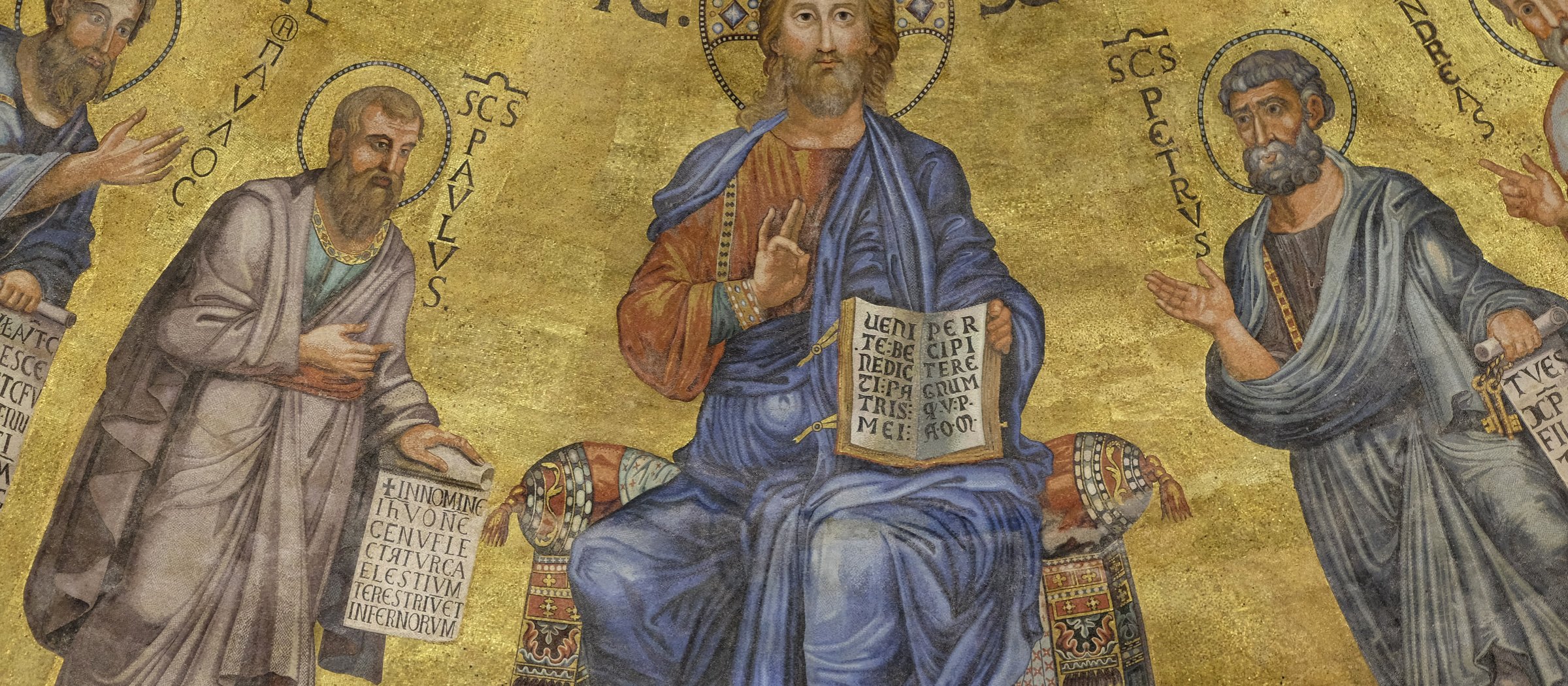
A Byzantine mosaic of Christ enthroned in glory, flanked by the apostles Paul, Peter, and Andrew.

From the Rector

An aside
on running
a race.

— The Rev. T.J. Thigpen

A few years ago I felt the need to fight back against a slowing metabolism and an increasingly sedentary lifestyle by getting in better shape physically. Needing some sort of goal to give direction to my exercise, I decided to run a race.

But what kind of race would I run? There were many options, from a 100-meter sprint to an ultra-marathon, and which race I chose would determine my preparation. Eventually I landed on a 10k with obstacles scattered throughout. Having set this as the goal, I was able to make a plan: an 8-week running plan with speed runs, intervals, long runs, recovery runs — all designed to build up endurance for 10k. I also began doing exercises to develop the strength I'd need to climb the obstacles I would face. And there were other things I needed: a sturdy pair of running shoes, headphones for the coach guiding me through my plan, a pull-up bar, nutritious food.

I did not come anywhere near the podium, but setting a goal, having a plan, and getting the tools needed to execute that plan helped me finish the race and get in better shape.

This is the role of vision, mission, and values. They give clarity on what we are heading towards, how to get there, and what we need along the way. The vision is the race we set our sights on. The mission is the plan we develop to run it. The values are the equipment we need to run it well.
The mission

The plan
for running.

How we pursue the truth, embody the goodness, and display the beauty of Christ together.

I.

Pursuing the truth

Some of this comes from preaching and teaching the Word. In the Liturgy of the Word we hear the truth proclaimed through the reading of Scripture and the sermon. We then stand and profess truth together in the Nicene Creed. Beyond Sunday, our Foundations class, Sunday School, and VBS are other ways we pursue truth together. We hope to grow more here — both in formal studies and in informal times of thinking together and encouraging each other in truth.

II.

Embodying goodness

We are to continue the work of our Savior who "went about doing good." This takes the form of seeking the physical and spiritual wellbeing of those around us — both inside and outside the church. We go out to meet needs: supporting a local food pantry and pregnancy clinic, making sandwiches for the homeless at the Light House shelter, giving aid to widows and orphans in Ukraine, and supporting missionaries throughout the world. And we welcome people in, loving and helping them through generous acts of hospitality.

III.

Displaying beauty

Beauty is best displayed in a saintly life — through people transformed by the grace of God, whose lives are ordered by their love for him. A well-ordered family also displays this beauty, sometimes called an icon of the Holy Trinity. But the beauty of Christ extends beyond well-lived lives. "Worship the Lord in the beauty of holiness" is given in the context of corporate worship. A beautiful liturgy matters. At St. Andrew's we have been blessed with a beautiful liturgy and beautiful music. The beauty we create may be but dim reflections of God's pure and holy beauty — but through them, God draws the faithful heart deeper into himself.

"Let us not grow weary of doing good, for in due season we will reap, if we do not give up."
Galatians 6:9

The values

What we need
along the way.

What we need most are minds, wills, and hearts that love Jesus and are intent on following him. Since truth, goodness, and beauty flow from God, those who are honestly seeking him will be best fitted to receive them.

But we have other needs too. We need volunteers willing to do the inconvenient and sometimes thankless tasks — teaching Sunday school, helping visitors feel welcome, running our sound booth, cleaning up after church. We need people willing to look about in their community, find needs, and seek to meet them. We need money to buy supplies and support missionaries. A place of our own, someday — a home that would open new opportunities for ministry and family life, and a chance to grow in the beauty of our worship — would also be a helpful piece of equipment.

Even more important than property, however, is prayer. We need people willing to spend time before God, seeking his favor for St. Andrew's, its people, and the communities it serves. Only God truly knows what we need to be faithful to him — and we will come to know those needs better as we spend time in prayer.

In closing

St. Andrew's exists to pursue the truth, embody the goodness, and display the beauty of Christ. Our goal in doing so is not to draw attention to ourselves or to build a popular brand. We are not seeking primarily to gain more people or more money so we can feel successful.

Rather, we are seeking to honor our Savior, Jesus Christ. Success is being faithful to him.

May God grant us grace to run our race well and faithfully together.